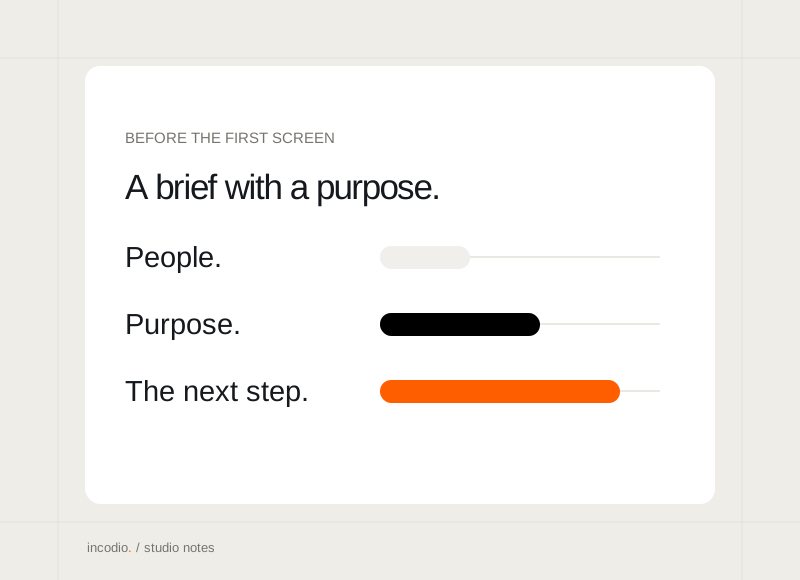
A website brief does not need to begin with a list of pages or a collection of visual references. Start with the people visiting the site and the decision you want to help them make. The pages, content, and interactions can then be shaped around a shared purpose.
Describe the people arriving
Explain who the website needs to serve and what may bring them there. A first-time buyer comparing providers will need different information from a returning customer looking for support. Identify the most important audiences and the questions they are likely to carry into the site.
Choose the next useful action
State what a successful visit might lead to: a project inquiry, a product trial, a booking, or a clearer understanding of an offer. There may be more than one useful action. Give them a priority so the site can guide people without presenting every option as equally urgent.
Take stock of the content
List the material you already have and what needs to be created or updated. Include service descriptions, product information, approved photography, and any real proof you are able to share. Be clear about permissions and missing assets. The design should work with truthful content rather than depending on claims that cannot be supported.
Explain what the website must connect to
Mention forms, booking tools, content publishing, account areas, or other systems the site needs. Describe who will maintain the content after launch. These requirements influence the structure of the work, even when they are not immediately visible in a visual reference.
Use references to explain a preference
Share the specific qualities you like: a calm navigation, clear type hierarchy, a particular image treatment, or an interaction that helps someone explore. Explain what feels relevant to your business. This gives the studio a direction to interpret rather than a template to repeat without considering your audience.